
NEWS
-
 Heating systems are essential for various industrial applications, providing necessary warmth and energy for processes and comfort. This article delves into key components and systems: steam boiler burners, boiler steam, steam generators, and skid thermal oil boilers and heaters.Read more
 -
Boilers are essential components in many industrial and residential heating systems. Understanding the various types can help in selecting the most suitable one for specific needs. This article explores six common types of boilers: oil-fired, diesel-fired, fire tube, coal-fired, natural gas, and coal boilers.Read more
-
Industrial boilers are essential components in many manufacturing processes, providing the necessary heat and steam for various applications. Among the different types, oil-fired steam boilers, diesel-fired steam boilers, coal-fired steam boilers, and thermal oil boilers are widely used. This article delves into these types of boilers, highlighting their functions, applications, and leading manufacturers.Read more
-
Steam boilers are integral to numerous industries, providing necessary steam for power generation, heating, and industrial processes. Understanding how steam boilers operate, where to find reputable manufacturers and suppliers, and how to maintain them is crucial for efficient and reliable performance. This article delves into the essentials of steam boilers, including their operation, leading manufacturers and suppliers, and where to find steam boilers for sale.Read more
-
Boilers play a crucial role in various industries by providing heat and power. They come in different types, each suited for specific applications, including steam boilers, thermal oil boilers, water boilers, and waste heat boilers. This article explores these different boiler types, highlighting their functions and applications.Read more
-
 Phase change materials are solid at room temperature and atmospheric pressure and turn into fluids when heated. Molten salts store the energy applied to convert them into liquids as latent heat, which they can transfer to other materials. As phase change materials, molten salts have a higher latent heat capacity than conventional materials. Minimal temperature changes are needed to increase their heat capacity.Molten salts are composed of nitrates, nitrites, carbonates, chlorides, and fluorides. Each compound has unique properties that make them useful for varying applications.Read more
 -
 Molten salt is salt which is solid at standard temperature and pressure but liquified due to elevated temperature. A salt that is liquid even at standard temperature and pressure is usually called a room-temperature ionic liquid, and molten salts are technically a class of ionic liquids.Read more
 -
 One of the biggest reasons molten salts are used for heat transfer is their ability to be used at high operating temperatures. Water boils at 100 ℃ and oil can be used up to approximately 350 ℃.That leaves molten salts, which can operate at much higher temperatures. Additionally, molten salts are not very corrosive. This means your equipment will remain in good condition with proper maintenance.Read more
 -
 Molten salts, also known as salt melts, comprise a variety of products that are used across many applications. Some applications that rely on molten salts include steel heat treating and annealing, high-temperature process heating, and thermal storage for solar thermal power plants. Depending on the needs of a specific application, different salts are available to use such as chlorides, bromides, fluorides, organic salts, and nitrates. Many applications use a eutectic blend of potassium nitrate and sodium nitrate.While there are several heat transfer fluid options available, molten salts are more ideal for certain applications due to the specific features unique to them.Read more
 -
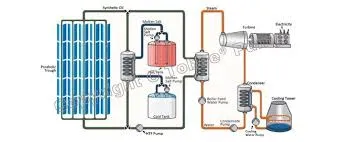 Molten salts are a phase change material used to store thermal energy.Phase change materials are solid at room temperature and atmospheric pressure and turn into fluids when heated. Molten salts store the energy applied to convert them into liquids as latent heat, which they can transfer to other materials. The heat transfer, therefore, occurs in two directions. When heat is applied, the salts melt. When the heat is removed, the liquid solidifies again.As phase change materials, molten salts have a higher latent heat capacity than conventional materials, and minimal temperature changes are needed to increase their heat capacity.Read more
 -
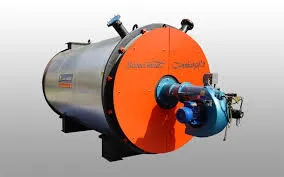 This article is about understanding the process of a molten salt heating system. Before this let us discuss different types of heating systems, which we use in our chemical industries.In our chemical plants, we need to heat exchange at various temperature levels. These temperature levels can be low, in the range of 50 – 130 0C, very high from 250 – 750 0C or even higher. Various heating requirements are like heat supply through reboiler in a distillation column, heat exchange in a fixed bed reactor to maintain the reaction temperature, thermal cracking of acetic acid in furnace coil, etc. We can divide these heat supply sources in two categories, first is indirect heating system and second direct heating system. Let us discuss each of them as below.Read more
 -
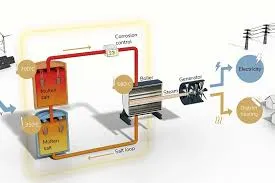 What is Molten Salt? Molten Salt is a rather dreadful name for an otherwise useful catagory of materials & processes. The term "Molten Salt" is self-descriptive; it is melted salt(s). Another common name is Fused Salt(s). The simplest example of a molten salt would be to heat sodium chloride ("table salt") to a red heat (greater than 801° C, or 1474° F)1 upon which it would melt into a liquid. This liquid is stable, has a heat capacity similar to water (by volume) and flows much like water does. The major differences are the obvious higher temperatures attainable in the molten salt state and when the salt solidifies (freezes) it contracts versus expanding like water. Thus, molten salt freezing in a pipe would not burst the pipe as water would.Read more