
NEWS
-
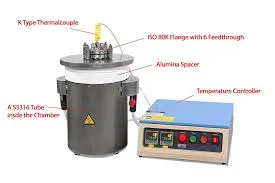 Thermal energy storage (TES) is the storage of thermal energy for later reuse. Employing widely different technologies, it allows surplus thermal energy to be stored for hours, days, or months. Scale both of storage and use vary from small to large – from individual processes to district, town, or region. Usage examples are the balancing of energy demand between daytime and nighttime, storing summer heat for winter heating, or winter cold for summer cooling (Seasonal thermal energy storage). Storage media include water or ice-slush tanks, masses of native earth or bedrock accessed with heat exchangers by means of boreholes, deep aquifers contained between impermeable strata; shallow, lined pits filled with gravel and water and insulated at the top, as well as eutectic solutions and phase-change materials.[4][5]Read more
 -
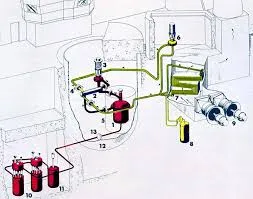 Molten salts are a phase change material used to store thermal energy.Phase change materials are solid at room temperature and atmospheric pressure and turn into fluids when heated. Molten salts store the energy applied to convert them into liquids as latent heat, which they can transfer to other materials. The heat transfer, therefore, occurs in two directions. When heat is applied, the salts melt. When the heat is removed, the liquid solidifies again.As phase change materials, molten salts have a higher latent heat capacity than conventional materials, and minimal temperature changes are needed to increase their heat capacity.Read more
 -
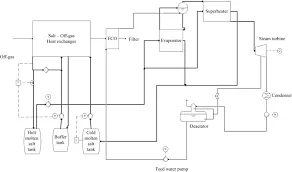 Molten salts have the advantage of very high liquid phase operating temperatures (1,000°F or higher) with little or no vapor pressure. Molten salts can replace organic or synthetic oils in heat transfer applications. While molten salts do offer a substantial benefit with their high operating temperatures, they can also have the undesirable characteristic of very high freezing points (ranging from 248°F to 428°F).There are three primary types of molten salt heating systems: salt bath heaters, circulated molten salt, and direct heating for applications like heat treating metal assemblies. There can challenges with all of these system types: metallurgy, instruments, system component selection, heat tracing, melting and draining, just to name a few.Read more
 -
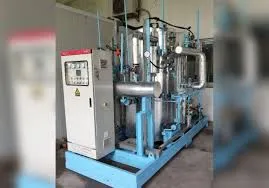 Molten salts are melted minerals used in various heating applications. Nitrate salts are the most common, although bromides, chlorides, fluorides, and even organic salts are used for this purpose. They are capable of operating under versatile temperatures and conditions, making them ideal for many heating applications.Read more
 -
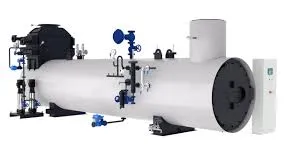
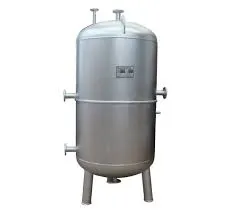 At the core of a steam boiler lies the boiler itself, a vessel designed to contain water and facilitate the controlled generation of steam. The boiler’s primary function is to transfer the heat energy produced by burning fuel to the water, transforming it into steam. This process occurs within a closed system, ensuring the integrity and efficiency of steam production. The design and engineering of boilers are carefully crafted to optimize heat transfer, fuel combustion, and steam generation, resulting in efficient and reliable performance.Read more
 -
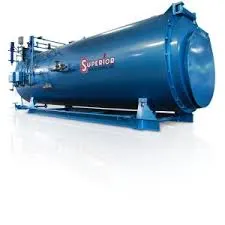 In today's world, where sustainable practices have become the need of the hour, numerous industries are striving to minimize their environmental impact. One crucial avenue for achieving this goal is by harnessing waste heat through advanced technologies like waste heat recovery boilers. These innovative systems serve not only as eco-friendly solutions but also offer a range of benefits, from economic gains to reduced carbon emissions. In this blog, we delve into the depths of waste heat recovery boilers, exploring their advantages and how they contribute to a greener and more sustainable futureRead more
 -
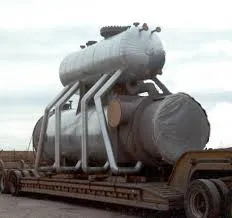 Waste heat is the heat which is generated in a process due to the combustion of fuel or due to a chemical reaction and then discharged into the environment without being put to practical use. Sources of waste heat include hot combustion gases discharged into the atmosphere, process off gases, conductive, convective and radiative losses from equipment and the heated products leaving various industrial processes (hot coke, hot metal, liquid steel, and hot rolled product etc.), and heat transfer from hot equipment surfaces (heat transferred to cooling water).Read more
 -
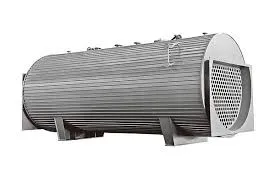 The fishmeal production industry is essential for providing protein for animal feed in the aquaculture sector. However, the industry faces challenges related to energy consumption and environmental sustainability. This study evaluates the energy efficiency and environmental benefits of waste heat recovery (WHR) technologies in a fishmeal production plant in Vietnam. Data were collected from the plant between 2016 and 2022, and a specific energy consumption (SEC) indicator and a comprehensive methodology were utilized. Implementing an economizer as a WHR technology resulted in a 55.5% decrease in SEC compared to the state before installation. The enhanced energy efficiency also translated to reduced energy consumption per output unit. Moreover, the economizer contributed to annual energy savings of 4537.57 GJ/year and cost savings of USD 26,474.49. Additionally, carbon dioxide (CO2) emissions associated with producing one ton of fishmeal decreased by 58.37%. These findings highlight the potential for WHR technologies to improve energy efficiency and reduce the environmental footprint of fishmeal production. The study’s results provide valuable insights for practitioners and policymakers in promoting energy efficiency practices and reducing environmental impact in this and similar industries.Read more
 -
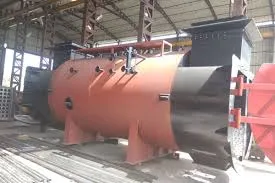 The most cost-effective use of waste heat is often to improve the energy efficiency of the heating process. This can be done by pre-heating combustion air or hot water feeds. After nearby preheating needs are met, opportunities for transferring waste heat energy to other areas of the plant can be explored.Making the best use of waste heat can be complex so it often pays to consult a relevant expert.Read more
 -
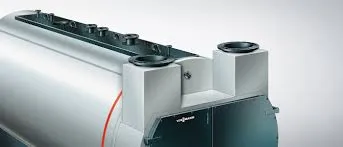 In the realm of industrial operations, the quest for enhanced efficiency and sustainable practices has led to innovative solutions. One such groundbreaking approach involves the recovery and utilization of waste heat generated during the operation of industrial boilers. This process not only optimizes energy usage but also proves to be a cost-effective and environmentally conscious strategy.Read more
 -
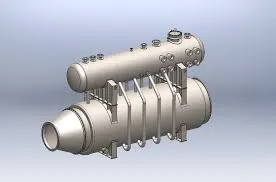 The energy transition/industry decarbonation movements that have recently accelerated require a tremendous amount of carbon-free electricity. At the same time, there are public oppositions to further installations of wind or PV farms as well as the development of nuclear and hydro, and geothermal can’t be expanded much. Biogas and syngas will continue to be further developed. Waste heat recovery (WHR) is a “low hanging fruit,” which only has one disadvantage: It presents a longer return on investment (ROI) than is usually acceptable to plants.Read more
 -
 With most of the world committed to limiting global warming to 1.5°C, many companies have set individual decarbonization targets for 2030 and even 2025. As we approach the end of 2023, we have only six years left to implement many decarbonization levers. But industrial companies are often uncertain about the right technical path to immediately reduce emissions. Technologies that are net present value (NPV) positive and quick to implement, such as various types of energy efficiency measures, can help companies achieve their decarbonization goals.Read more